Agentic Autonomy Levels
A working model of autonomy for agentic engineering
Highlights
Passages saved from the original.
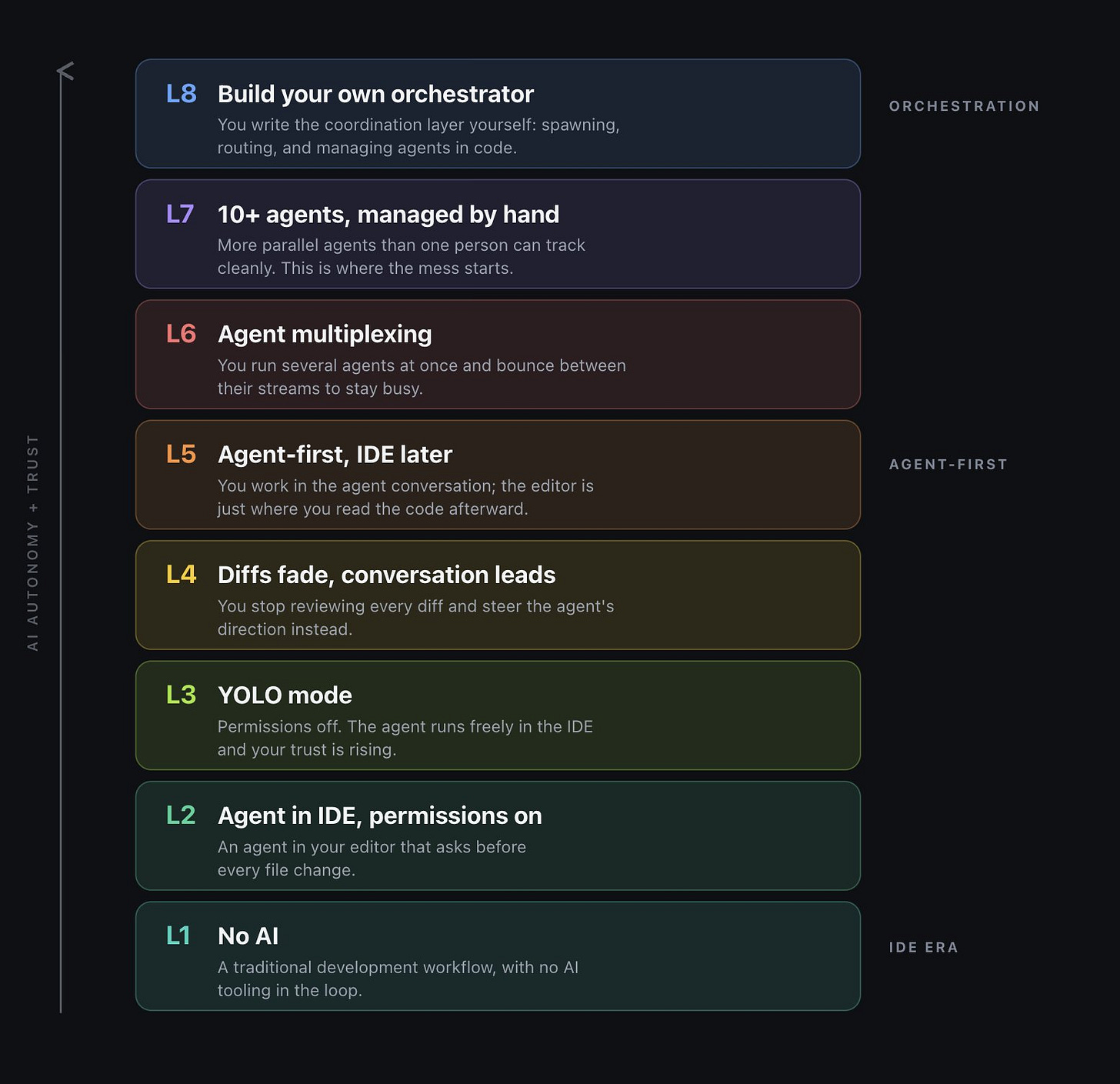
- In most conversations about agentic engineering, the action has changed from prompting to operating
- The edge of the frontier is the manager agent that wakes on its trigger, delegating to its helpers while continuously verifying their output, and returning with only the decisions that must be made by a human.
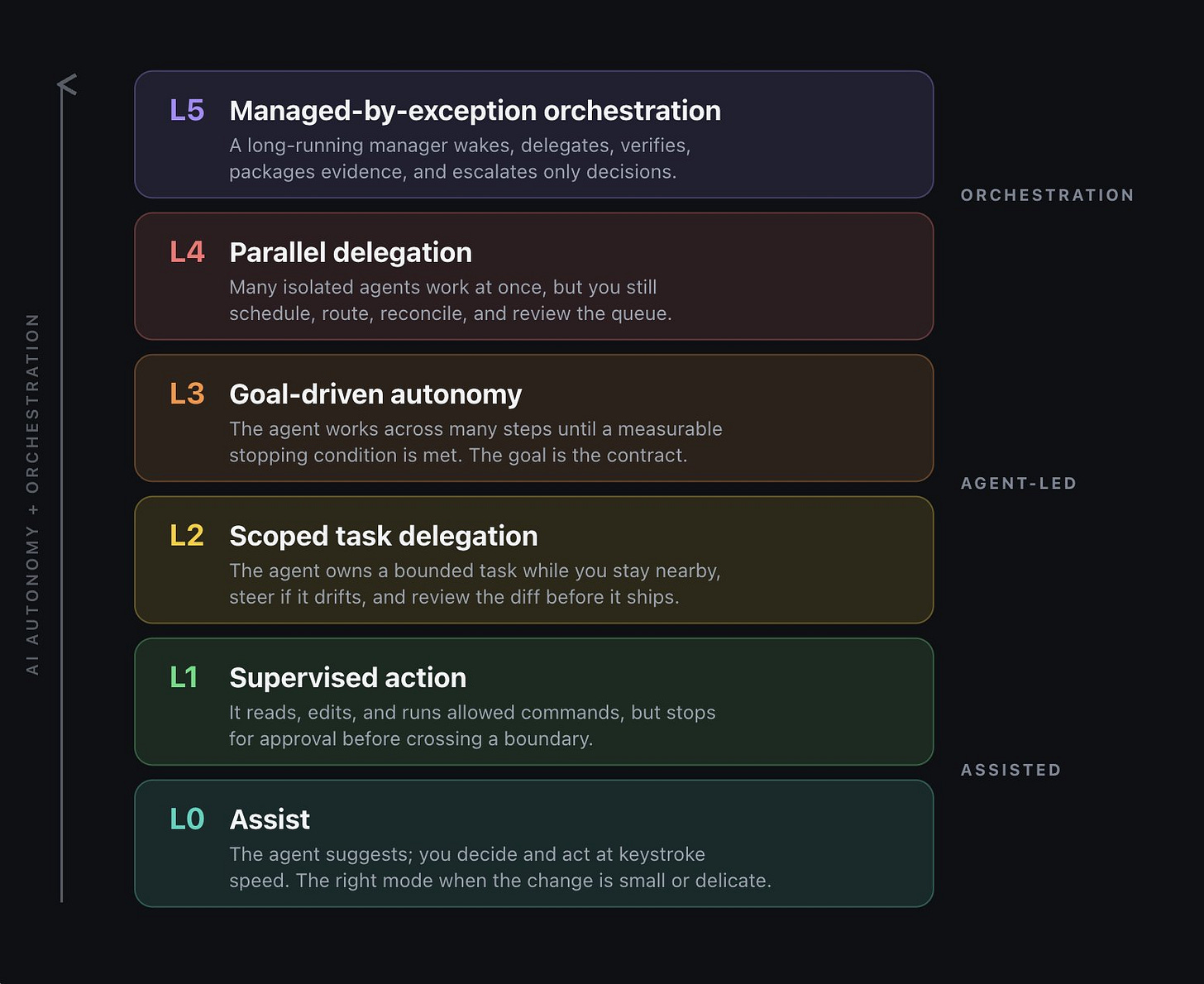
- The agent does whatever it takes to achieve a goal, stopping only when some condition is met. In prompt mode, this means the prompt itself becomes the goal (e.g., “Can you reduce this page’s time-to-interactive below 1 second?”). In Codex, this is Goal mode: the agent cycles through plan->act->test->review steps until it stops meeting success criteria. In Claude Code, it’s the /goal, /loop, and /schedule commands. For this level to be useful, the stopping condition must be measurable in a way that can be automated.
- Don’t ask your agent to help with vague, wooly goals like improving user experience in general” or “make the codebase more testable.” Pick something specific, measurable, and automated
- Define what success looks like, and which policies should apply. A manager agent will wake up based on triggers (e.g. new issue, new task, clock), dispatch worker agents, monitor their progress, verify output, retry on failure, escalate to more competent agents or humans when conditions are met
- Verification will always be the bottleneck.
Summary AI-generated
Summarised by an AI assistant when this source was saved. Double-check against the original.
In summary, the most significant shift is moving from prompting to operating agents where verification is the permanent bottleneck, requiring calibrated autonomy based on risk and reversibility.
- Agents have shifted from prompting to operating, requiring managers to verify outputs and define goals with measurable stopping conditions.
- Six autonomy levels define a progression from supervision to managed-by-exception orchestration, with evidence rather than task complexity determining the ceiling.
- Risk and reversibility set the autonomy ceiling, while anti-patterns like permission laundering must be avoided to prevent system failure.
- Metrics like mean time between interventions and rework rates should be tracked to ensure reliability and continuous improvement.
Also cited by
- How AI changes the software engineer roleEstablishedfurther reading
Good foundation is still key. AI is a signal amplifier, not just a tool. It will amplify the good and the bad. System design is still very important (some say that hyper-generalists…
- AI Loop EngineeringGrowingfurther reading
Smolagents vs langgraph. To test the output of your models, you can rely on both deterministic and non-deterministic guardrails (LLM as Judge). Remember that AI outcome is not deterministic so it's safer…
- Levels of agentic programmingGrowingfurther reading
Use AI for code reviews when the risk is low.