Inside OpenAI’s agentic software factory
A deepdive into how Codex has “taken over” OpenAI, how the frontier lab builds its agentic software factory, and the engineering challenges of one billion users. Details from inside OpenAI
Highlights
Passages saved from the original.
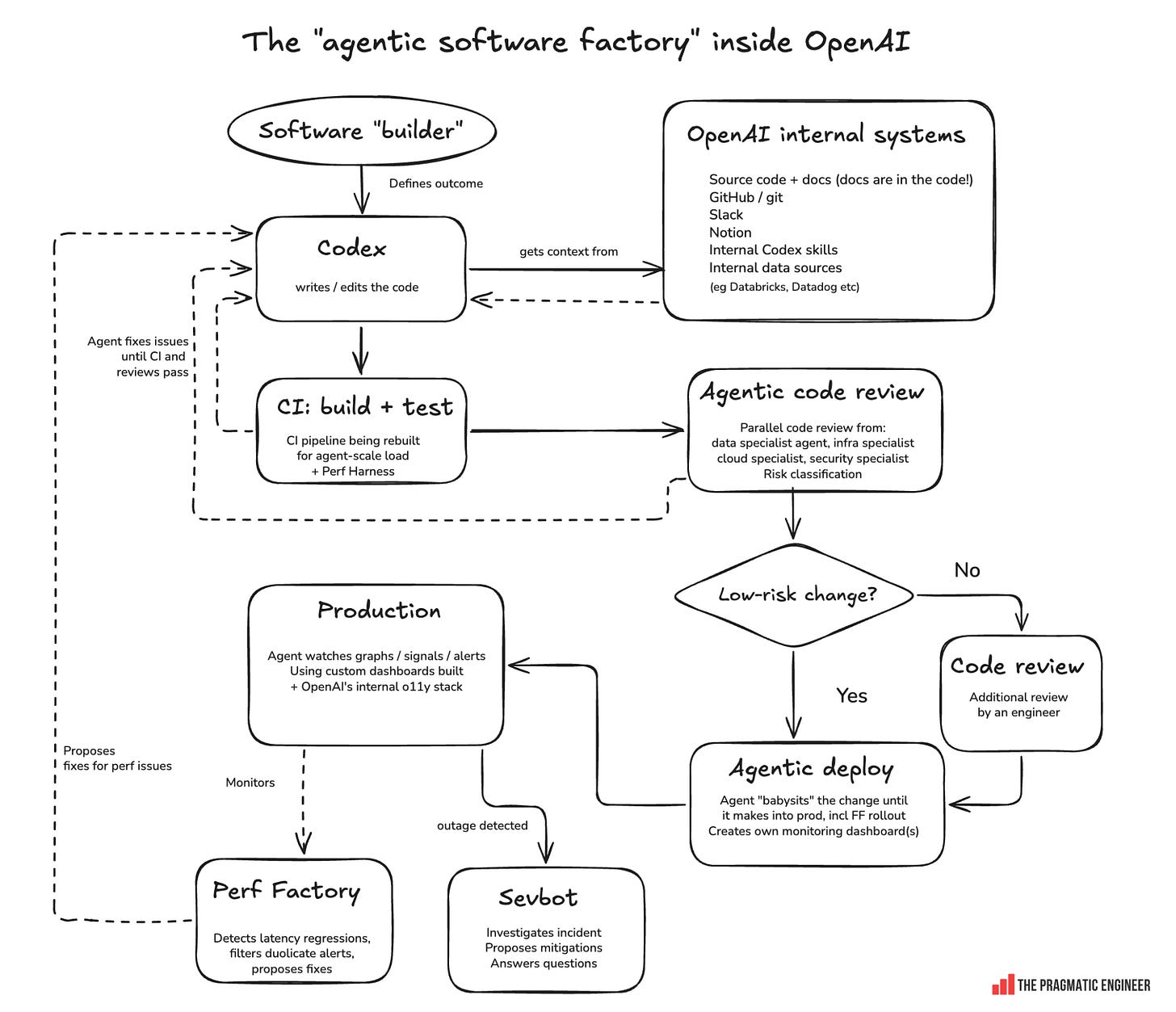
OpenAI’s “agentic software factory”
Summary AI-generated
Summarised by an AI assistant when this source was saved. Double-check against the original.
In summary, OpenAI has transitioned from using AI as a tool to operating as an \"agentic software factory\" where Codex agents autonomously handle the majority of the coding, reviewing, and deployment lifecycle, fundamentally altering the role of the software engineer.
- Widespread Agent Adoption: Codex and ChatGPT Work have moved beyond engineering to 90% adoption in non-technical departments, enabling long-running, goal-oriented automated workflows.
- Evolution of Dev Tools: Traditional IDEs and manual pull requests are declining as agents handle code generation and multi-lens automated reviews, though this has increased CI/CD system load by up to 10x.
- The Agentic Software Factory: OpenAI employs a closed-loop system where agents define, implement, test, deploy, and monitor code, including \"per-change\" autonomous monitoring dashboards.
- Changing Engineering Roles: Software engineering is shifting away from manual implementation toward high-level judgment, agency, and product management.
Also cited by
- AI Multi AgentEstablishedfurther reading
They have an architect, scout, coder, reviewer and verifier. https://github.com/jarod-rosenthal/workermill. They have a planner, a developer (frontend, backend, devops), a tech lead. The tech lead reviews the code. Up to 3 times.