Article
Top AI Agentic Workflow Patterns
In this article, we will look at the most popular agentic workflow patterns and how they work.
Highlights
Passages saved from the original.
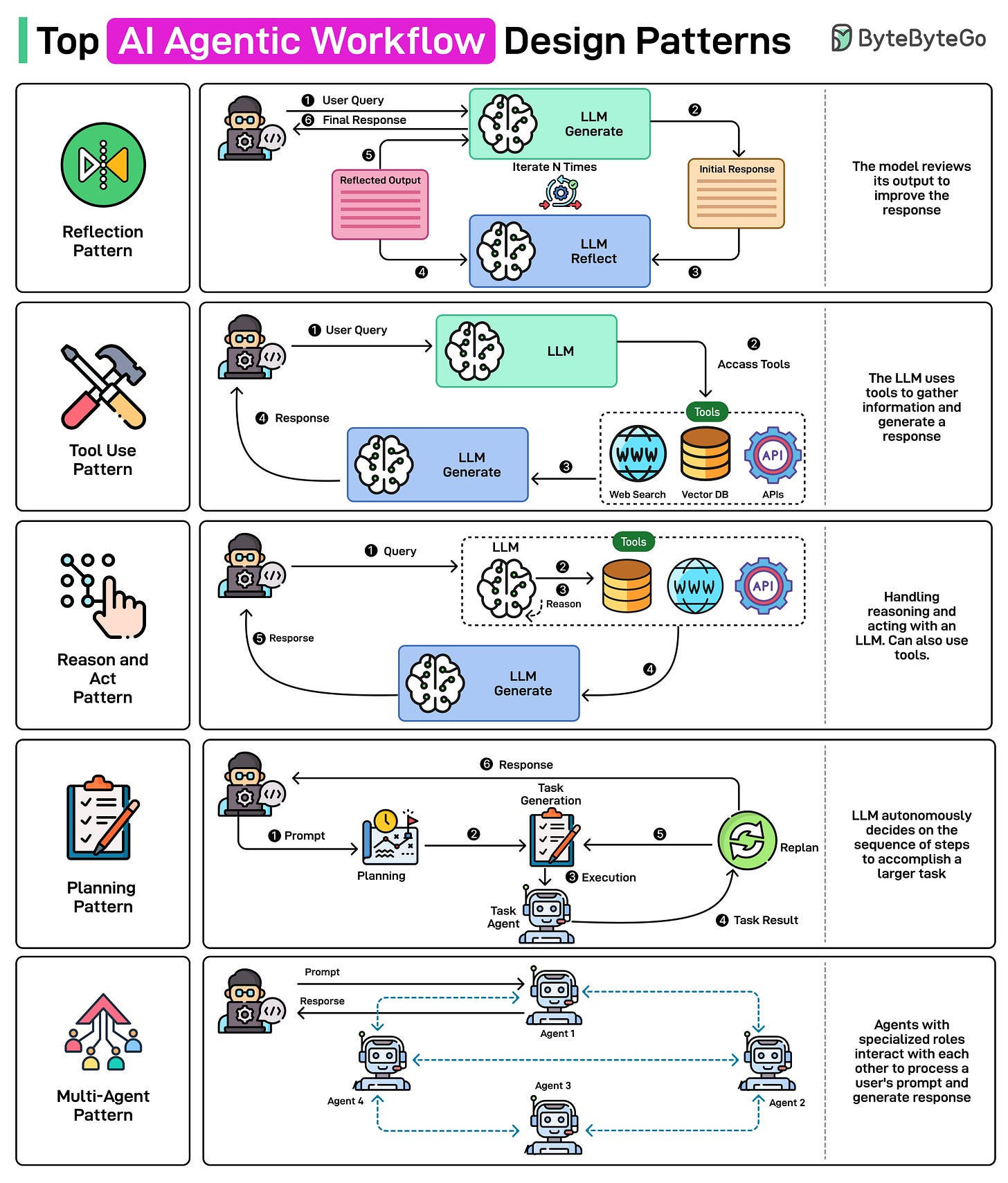
- What makes workflows truly agentic are the iteration and feedback loops built into the process. Instead of generating output in a single pass, agentic workflows involve cycles where the agent takes an action, observes the result, and uses that observation to inform the next action. This mirrors how humans actually solve complex problems
-
- There are often critics or review agents whose job is to evaluate outputs from other agents, identifying flaws, suggesting improvements, or verifying quality.
-
- There’s usually a coordinator or orchestrator agent that manages the overall workflow, deciding which specialist should handle each subtask and ensuring all the pieces come together coherently.
- The multi-agent pattern introduces complexity trade-offs as follows:
-
- Coordination overhead increases with more agents.
-
- Communication between agents requires clear protocols.
-
- Debugging becomes more challenging because problems might arise from interactions between agents rather than individual agent errors.
- For simple tasks, a single capable agent is almost always better
Summary AI-generated
Summarised by an AI assistant when this source was saved. Double-check against the original.
In summary, the most compelling insight is that reliable AI automation requires shifting from static prompt engineering to dynamic, iterative agentic workflows that continuously adapt, reason, and leverage external tools.
- Single-turn prompting falls short for complex tasks; reliable automation requires iterative, feedback-driven agentic workflows.
- Five core patterns enable advanced AI: Reflection for self-correction, Tool Use for external capabilities, ReAct for adaptive reasoning, Planning for structured execution, and Multi-Agent for specialized collaboration.
- Pattern selection should align with task complexity, speed needs, and uncertainty to avoid unnecessary overhead.
- Combining multiple workflow patterns typically produces the most robust and scalable AI systems.
Also cited by
- AI WorkflowGrowingfurther reading
Models are so good now that they're not to blame for code quality. If there is an issue, it means there's a gap in the system/prompt/workflow.