Article
🧱 Your Multi-Agent Architecture Is a 2016 Microservices Diagram With the Boxes Renamed
Multi-agent systems are microservices where every call runs an LLM. Which patterns transfer, which break, and one heuristic for deciding when to split agents.
Highlights
Passages saved from the original.
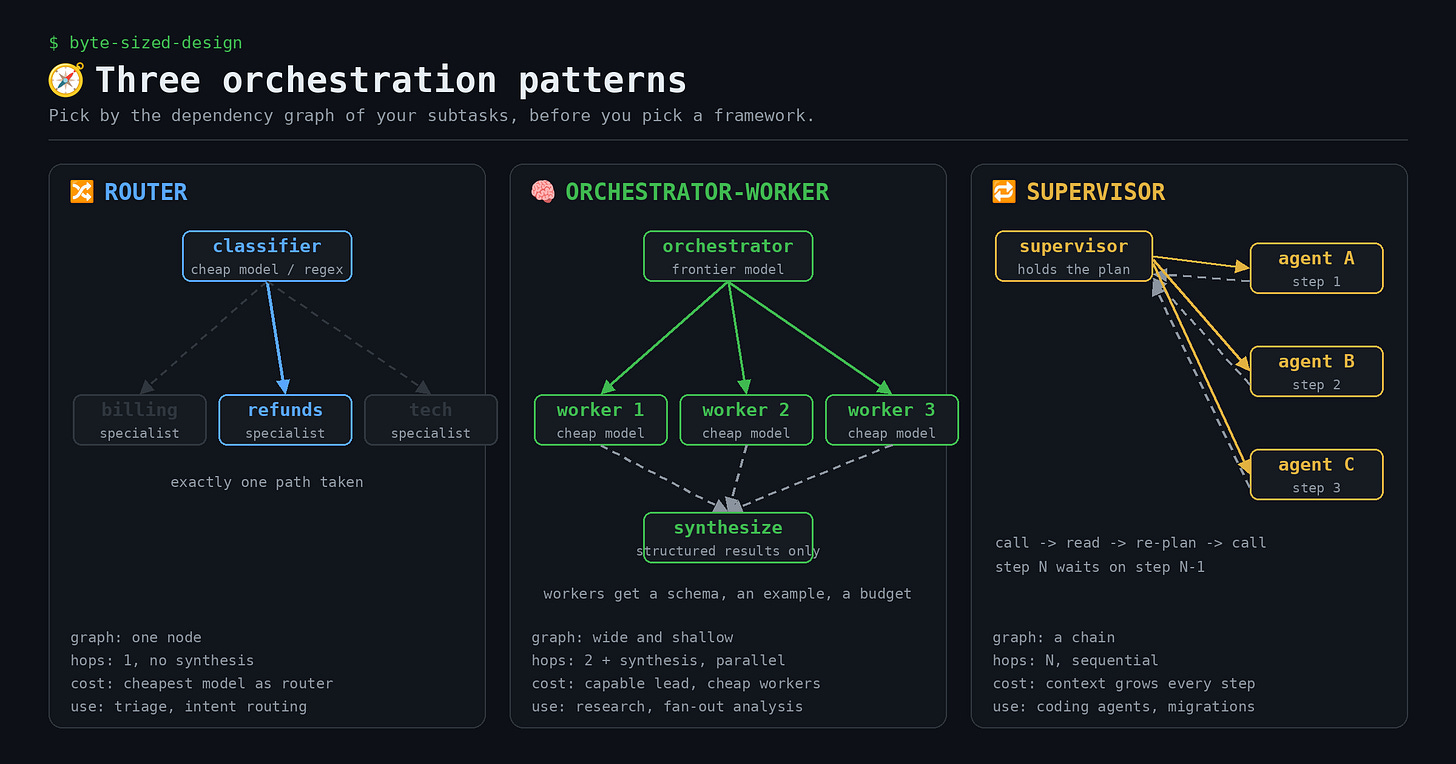
- Router. A cheap classifier reads the request and forwards it to exactly one specialist, one hop with no synthesis step.
-
- Use for: support triage, intent routing in a product assistant, any case where the categories are known and the work per category is self-contained
-
- Router model: your cheapest one, a fine-tuned classifier, or a regex if the categories are clean enough
-
- Common mistake: letting the router “help” by adding context. It should classify and get out of the way
- Orchestrator-worker. One capable model decomposes the task, dispatches subtasks to workers, and synthesizes the results. Workers are stateless, parallel, and can run on a different model than the orchestrator.
- This is where the cost story lives:
-
- Orchestrator-tier and worker-tier models from the same vendor sit 5x to 15x apart on per-token price
-
- In a decomposed task, most tokens are worker tokens
-
- The number circulating in vendor write-ups this year is a 40 to 60 percent cost reduction versus running everything on the frontier model. Those write-ups are selling something, but the mechanism is sound
-
- Anthropic’s public data point: an Opus lead with Sonnet subagents beat single-agent Opus by 90.2 percent on their research eval. The same post reports multi-agent runs burn ~15x the tokens of a chat interaction, which is the other half of that ledger
- Two rules for making it pay:
-
- Workers get a schema, an example, and a budget. Nothing else
-
- The orchestrator sees results, never raw worker transcripts, or your context bill grows with every worker you add
- Supervisor. A loop rather than a fan-out. One model holds the plan, calls an agent, reads the result, revises the plan, calls the next one.
-
- Sequential and stateful. The supervisor’s context accumulates every result
-
- Use for: long-horizon tasks where step N depends on step N-1 (coding agents, migration tooling, multi-stage pipelines)
-
- Wrong for: anything parallelizable. It turns a 4-second fan-out into a 40-second chain
Summary AI-generated
Summarised by an AI assistant when this source was saved. Double-check against the original.
In summary, while multi-agent architectures mirror microservices in structure, they break the traditional playbook because the \"physics\" of a call has shifted from millisecond-latency deterministic requests to multi-second non-deterministic inference passes.
- Treat agents as microservices by using typed contracts (like MCP) and narrow prompts to avoid the \"monolith problem\" of degrading performance.
- Implement containment via tool-call budgets, model-tier fallbacks, and selective retries to manage non-deterministic failures.
- Choose orchestration based on task dependency: use Routers for triage, Orchestrator-Workers for parallel tasks to save costs, and Supervisors for sequential chains.
- Maintain full logs of prompts and outputs keyed by trace IDs, as standard distributed tracing is currently insufficient for debugging agent reasoning.