Summary AI-generated
Summarised by an AI assistant when this source was saved. Double-check against the original.
In summary, the most compelling insight is that database scaling is not about finding a single perfect solution, but rather strategically balancing the trade-offs between performance, data consistency, and system complexity across different techniques like indexing, caching, and sharding.
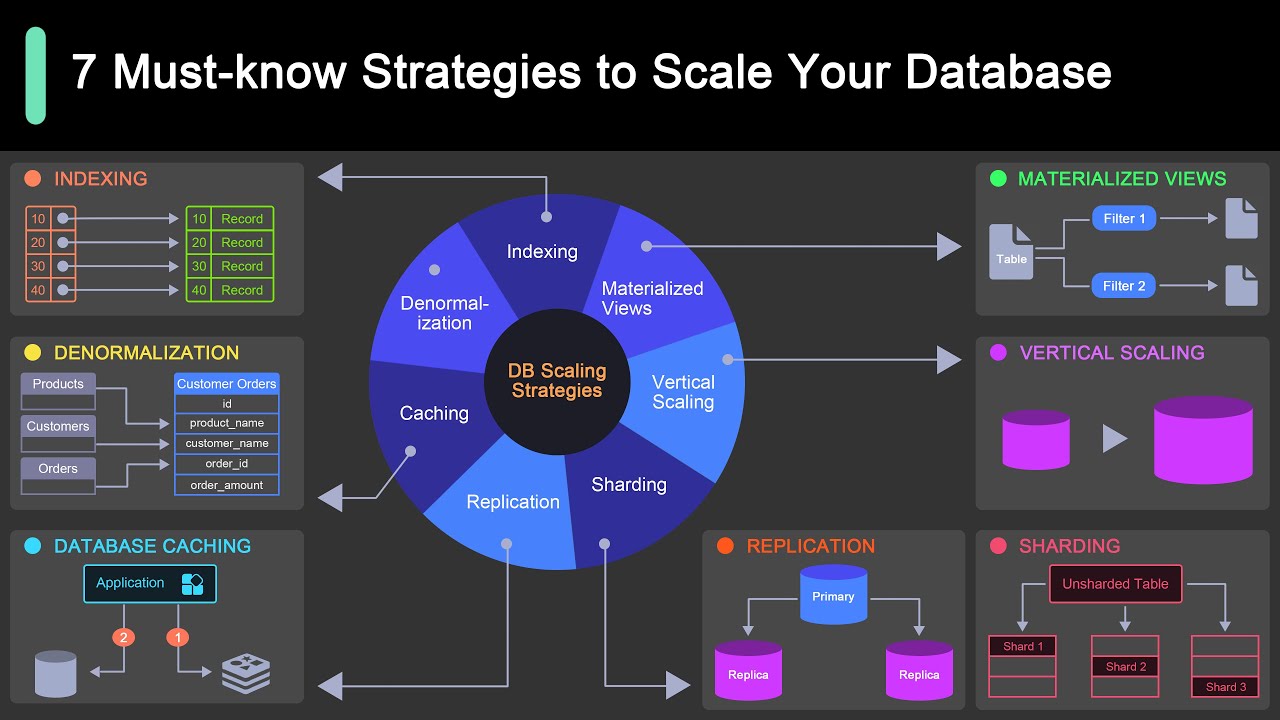
- Scaling is essential to maintain performance and prevent crashes as data volume and user traffic grow.
- Indexing (like B-tree) drastically speeds up read queries but adds overhead to write operations.
- Materialized views store pre-computed results for complex queries, improving speed at the cost of refresh maintenance.
- Denormalization simplifies queries by storing redundant data, boosting reads but complicating consistency.
- Vertical scaling upgrades single-server hardware for quick gains but hits physical limits and lacks redundancy.
- Caching reduces database load by storing frequent data in memory, requiring careful invalidation strategies.
- Replication copies data across servers for high availability, trading off between synchronous consistency and asynchronous speed.
- Sharding horizontally splits data across multiple servers to handle massive scale, though it complicates querying and rebalancing.
Also cited by
- ScalabilityGrowing
A service is scalable if it results in increased performance in a manner proportional to resources added. Generally, increasing performance means serving more units of work, but it can also be to…