Summary AI-generated
Summarised by an AI assistant when this source was saved. Double-check against the original.
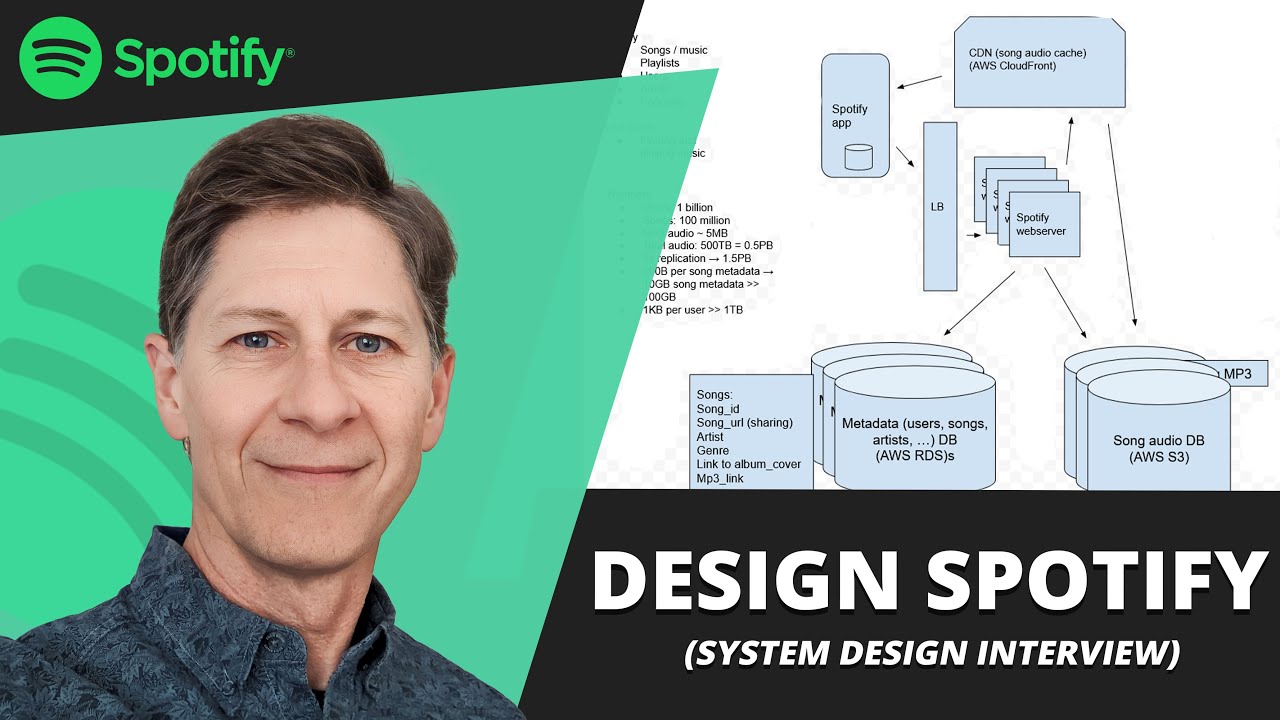
In summary, the most interesting aspect of this interview is the candidate's systematic approach to handling scale and performance bottlenecks, particularly through the implementation of multi-layer caching and the strategic split between relational metadata storage and object storage for audio files.
- Constrain the problem scope early by identifying core use cases to keep the design focused and feasible.
- Perform back-of-the-envelope calculations to estimate storage requirements, data size, and user scale.
- Separate storage by access patterns, using relational databases for mutable metadata and object storage for immutable audio blobs.
- Identify hot content bottlenecks and implement multi-layer caching (device, CDN, application server) to reduce latency and backend load.
- Optimize load balancing metrics for streaming workloads by monitoring network bandwidth and I/O rather than relying solely on CPU usage.
- Apply geo-aware replication strategies to place data closer to regional users and minimize latency.
- Clearly communicate design trade-offs and acknowledge knowledge gaps to maintain transparency and guide the interview collaboratively.
Notes this inspired
- Load BalancerEstablished
Single point of contact for user requests. It does health checks for all servers to know if some have issues. Distribution: Round Robin: simple and sequential. IP hashing: allows the same user…
- CDN - Content Delivery NetworkGrowing
Spread out servers that store copies of content. Page load will be faster as there will be a server closer to the user's location, usually. These usually store and cache content like…
- How much data is a user in a database roughlyGrowing
1KB ish. Some common fields: But what takes most space is database overhead, index, page, etc.
- Immutable data vs mutable dataGrowing
An image or a song would be immutable data. The access pattern for those is a lot of reads, very few writes. These would be best stored in a system where it's…
Also cited by
- System Design interviewEstablished
Allocate specific time slots: 5m for requirements, 20m for high-level design, 15m for deep dive, and 5m for wrapping up. Define requirements and use cases. functional requirements first, and non-functional requirements if…